Sunday, 19 May 2013

Balsamic Vinegar


If you asked anyone to list ten typical Italian ingredients, it would be safe to say that Balsamic Vinegar would probably be mentioned by most of them, and there is a good reason for this. Balsamic vinegar,  or as it was once known Siroppo Acetoso,  has been known throughout Italy since the middle ages. These medievil Siroppo Acetoso were simple things, just a syrup which was naturally fermented into a vinegar, which at the time was not used a culinary ingredient but was sold as a medical preparation. Noble families, like the d'Estes, proudly owned their own acetaia, a loft where they fermented the own Siroppo. In the 17th century, aristocratic circles in Modena began discussing a tincture described as  Balsamico, which was said to have such rejuvenating powers that it could bring the dead back to life. As we now know, Balsamic Vinegar does not quite live up to this reputation, but the description is aiming in the right direction. Anyone who has had the pleasure of tasting a genuine Aceto Balsamico Tradizionale with its thick, rich harmonies of sweetness, sourness, velvety smoothness and piquancy, can well understand how just a few drops of Balsamic can bring even the most lifeless ingredients "back to life".

But why is Balsamic so different to other vinegars . . . ? Well why in most vinegars the raw ingredients ae either red or white wine, the first stage of making Balsamic Vinegar is making a must from white Trebbiano grapes from Modena and. Reggio Emilia. The must is gently heated up and concentrated, until it reduces down to a thick brown, sticky, syrup. This grape juice is then mixed with old wine vinegar to start the fermentation process. Balsamic vinegar, un-like other vinegars, is not made in cool, temperature controlled cellars, but in creaking, old lofts, which are ice cold in winter, stifling hot in summer and damp during the spring rains and autumn mists. Balsamic vinegar needs these unfavorable climatic conditions to keep reducing its volume (10 gallons of must will produce only a few pints of Balsamic Vinegar), to mature and to develop its characteristic flavours. It takes about three years to complete its two fermentations. The first fermentation is whe the sugar in the must is turned into alcohol. Onl when tha process has been completed can the vinegars natural bacteria convert the alcohol to vinegar.


But even this second fermentation is just the beginning for Balsamic Vinegar. Once this three year fermentation sequence has finished the Balsamic must then be matured, for atleast 12 years but sometimes upto 30 or even 50 years. In the vinegar loft, which is known as a acetaia, the will always be a whole row of different-sized barrels made from various woods, each of which impart their own flavour and character into the vinegar. Balsamic vinegar is not matured in a single barrel, it is transferred from one barrel to another during its maturation period. The mature Balsamic Vinegar is drawn off in small portions from the oldest barrel, then quantity removed from this barrel is replaced by a the same quantity from a the second oldest barrel, which is replaced by the same quantity from the third oldest barrel, and so on. The sediment and mothe found in the barrels, which are sometimes very, very old, are the most treasured possessions of the producers of balsamic vinegar, but the wood of the barrels also plays an important part. Ash and Oak are used for the smallest barrels, chestnut and cherry are used for the middle sized barrels, and the younger vinegars are best matured in Mulberry. Every producer has an opinion on the subject of the ingredients added to the maturing Balsamic, but it is generally a selection of, or all of, cinnamon, cloves, mace, coriander, and liquorice.

Nowadays Balsamic vinegar is also made in factories which can sometimes achieve reasonable results, but never as good as the artisan vinegars of Modena. These mass produced Balsamic vinegars are cheape to produce but generally lack the flavour, character and quality of proper Balsamic vinegar. Very cheap Balsamic vinegars should be avoided, as the will probably be little more than regular wine vinegar with a few spices and some caramel added for colour.


Genuine Balsamic vinegar can be recognised by it's price, it's small often ornate bottles and by the official declaration Aceto Balsamico Tradizionale di Modena, or Aceto Balsamico Tradizionale di Reggio Emilia. The consortium in Modena has been in existence since 1987 and has 270 members who are permitted to add the crucial word Tradizionale to their labels. The description Tradizionale di Reggio Emilia is also legally protected.

Saturday, 18 May 2013

Marsala


In 1770 a young Englishman, John Woodhouse, was forced to seek refuge in the Sicilian port of Marsh-alla. The port, with it's Arabic name  can be roughly translated to "Port of God", is situated on the western coast of Sicily and belongs to the town of Marsala, and it was here that Woodhouse would make discover a wine which would change the World wine market. Woodhouse, the son of a Liverpool merchant, was on his way to Mazara del Vallo, in southwestern Sicily to pick up a consignment of soda ash for his father. However, a storm that almost shipwrecked Woodhouse, forced him to take cover in the port of Marsh-alla to ride out the storm. As anyone would when forced to take cover in a strange place he headed straight for the local inns looking for a bed, some food and some wine. It was in one of these inns that Woodhouse first sampled the thick, sweet, dark wines of Marsala, that he believed could easily compare with the most expensive sherry of Spain and Portugal. 

So taken with the wines, Woodhouse contacted his wife-to-be, who worked for a wine producer in Madeira, to come immediately and join him. After extensive sampling they both agreed that the wines held great global potential and could even possibly break the monopoly on fortified wines held by the wines of Madeira and sherries of Spain. Woodhouse, with the backing of his fiancĂ©e and father, took on the difficult task of marketing Marsala to the rest of the world. Although Sicilian grapes were easy to get hold of and local labour was very cheap it still took a the year trail period before the first production of Marsala was shipped to England where, to both Woodhouse's delight and relief, it was instantly a hit and quickly became very popular. This quickly lead to Woodhouse instituting regular shipping runs between Marsala and Liverpool to cope with the ever increasing UK demand fo the wines of Marsala. 


Seven years later Woodhouse got the breakthrough he needed in the shape of a state order. In 1800, Admiral Nelson sent a written commission for 500 barrels of Marsala to be supplied each year to the English fleet based in Malta. Five years later Nelsons fleet won the decisive victory at the battle of Traffalger against the combined fleets of France and Spain, Marsala was heralded around the world by the returning British fleet - as Marsala "The Wine Of Victory". Alas, this sudden global popularity was to eventually become the downfall of Marsala wine. When this sudden high demand lead to a shortage of Sicilian grapes, Woodhouse had the ingenious idea to increase production by advancing farmers the necessary capital to grow more grapes and produce more Marsala, but at the same time Woodhouse still retained the right to set the price for any grap or basic wines the farmers supplied. Woodhouses success lead to competition and in 1806 another Englishman, 22-year-old Benjamin Ingham arrived in Marsala and quickly set up a new, bigger an technically more advanced production plant at Lugomare Mediterraneo, just a short distance away from Woodhouse's stronghold. Ingham new that the key to success was the farmers, so he began his own campaign to get the growers on his side. At harvest time Ingham sent town criers to offer production tips to small producers on how to improve the quality and productivity of their vineyards. Ingham established a ten-point plan for ensuring quality, some of Inghams points are still used today by some of Marsala's greatest producers. As with many other Italian wines this increased demand comes the temptation to short-cut which, in the case of Marsala, lead to a dramatic fall in quality and therefore popularity.

In 1833 a Sicilian entrepreneur decided to take the fate of Marsala into his own hands. By using the name of a friend, Vincenzo Florio, acquired a large vineyard estate, which bordered Woodhouse's property on one side and Inghams estate on the other. This lead to the unstoppable rise of Marsala Florio S.O.M - with its familiar trademark of a drinking lion. On the deeds founding the firm belonging to Vincenzo Florio were signed on October 20, 1834, and strangely still to this day refer to the production of a Madeira-type wine, not a Marsala. Even though Woodhouse will be forever accredited wit the discover and marketing of Marsala, it was Ingham who first established the ethos of quality over quantity, and Florio who finally developed a truly marketable wine, the demands for which grew year by year. Despite the initial difficulties, Florio won over the local grape producers and Marsala's worldwide success was now in local hands.


There are various types of Marsala produced, even today, some of which - such as the notoriously inferior wines of Marsala all' Uovo - have fortunately gone out of fashion. There are lower alcohol varieties called Oro, made from white grapes, and Rubino, made from red grapes and there is even a aromatised variety which is flavoured by various means, but probably the most interesting Marsala's are called Fine, Superiore, Vergine and Vergine Stravecchio. These quality Marsala wines can be up to 18 per cent proof and man are now matured for four, six or upto ten years in cask before being bottled and sold. Marsala in all it's different forms are an ideal aperitif or dessert wine. 

Seasoning - A Matter Of Balance


Due to the simple flavours of Italian cooking, seasoning is of great importance to both balance and enhance the natural flavours of its ingredients. In Italian cooking you must remember seasoning is not just salt and pepper, it can be anchovies, capers, chilli, fennel seeds and so on, all of which add new dimensions of flavour to your dishes. I think of seasoning as an essential element of good food, if you under- season, you are taking away a dimension of flavour, if you over-season you are completely obliterating a flavour dimension from your food. By adding a few good pinches of salt to your boiling water before cooking pasta, you can give your pasta more flavour, however you must consider what your sauce is made of. Ingredients such as anchovies, capers, olives, Pecorino, Parmesan, pancetta, prosciutto or any cured products, all give dishes a salt flavour and by adding these to seasoned pasta will alter the balance of your dish some primes making them too salty. Other ingredients such as vegetables and tomatoes benefit from the addition of a little salt to enhance their flavours, especially in the case of tomatoes which I think often benefit from a twist of pepper. 

One of the easiest ways to get your seasoning correct is so simple . . . taste while your cooking.This may seem obvious to many of you but it is often forgotten by most people, who simply taste their food just before serving, when alas seasoning can rarely, truly be corrected. Whilst preparing your ingredients taste them, for example different brands of anchovies and capers can have vastly different salt flavours or when preparing ingredients for ravioli fillings, stuffings, meatballs and so on, just take a minute to cook just a little of your mixture in a pan and taste the end flavour, this will allow you to check and correct your seasoning before preparing the dish. Simple steps really but so often forgotten, but remember when cooking for many people, flavour is very subjective, and essentially comes down to personal taste. It must also be remembered that as well as adding flavour to a dish, to much salt will also extract moisture and dry out your food. When cooking meat and fish, season it before cooking it as this will allow the flavours to penetrate the ingredient. Cooked ingredients will not absorb and naturally disperse seasoning as well as raw ingredients, the seasoning will simply sit on the outside and concentrate in flavour. 

Different ingredients must be seasoned in different ways, mainly due to the chemical changes that salt and pepper have on the ingredient. For example Liver if seasoned to far ahead of cooking will form small pits in its surface due to its reaction with the salt, similarly dried peans and pulses, unlike other vegetables, must only be seasoned after they are cooked as the presence of salt will cause their skins to dr out and become unpleasantly tough.

We all know about the risks of salt to our health, especially that of our children, but it must be remembered that most of these problems come from mass manufactured foods. A shop bought, jarred tomato sauce will often contain a large quantity of salt, but by simply cooking a handful of fresh tomatoes, with chilli, garlic and olive oil your sauce will only contain the natural salts of its ingredients or any salt you add yourself and and probably lots less fats and far more flavour. When buying salt remember that natural sea salt or rock salt is very different from commercially produced table salt which is often chemically enhanced and bleached. Similarly, freshly ground black pepper will have more aroma, warmth and a far cleaner flavour than its commercially produced white alternative. 

In today's world of supermarket shelves full of perfect looking products where everything is the same it must be remembered that this bland, characterless uniformity extends into the flavour. A naturally reared, free-range, well- hung piece of beef will need far less seasoning than its chemically enhanced, mass produced alternative. The same can be said of vegetables, by eating vegetables in their natural season, from a good trusted grower will need very little seasoning to enhance their natural goodness and flavours.


Mandilli di Seta (Silk Handkerchief Pasta With Pesto)


The Recipe
 
For Pasta
 
250g Italian ‘00’ flour, plus extra for dusting
1 egg
3 egg yolks
2 tbsp olive oil
pinch of salt

For Pesto

large bunch basil
10g sea salt
40g pine nuts
4 garlic cloves, peeled
100ml olive oil
80g Parmesan, freshly grated
 
 
To make your pasta, place the flour in a bowl or on a work surface, and make a well in the centre. Add the egg, yolks, half the oil and a pinch of salt. Firstly with a fork and then with your hands, gradually mix the flour with the eggs and oil until you obtain a rough paste.

Knead the dough on a lightly floured surface for a few minutes until it is smooth, not sticky. Cover with a cling film and leave to rest in the fridge for atleast half an hour, but over night would be better.

Once rested divide the dough into quarters. With a rolling pin, roll out each piece of dough in turn until you have a 1mm thin dough, without it sticking or ripping. (If you have a pasta machine, place the dough through the rollers gradually, starting with the highest setting, until you have sheets about 1mm thick).
 
Cut the sheets of pasta into large squares, about 15cm by 15cm, and dust with flour to prevent them sticking together.

To make the pesto, put the basil leaves in a  mortar with the salt, pine nuts and garlic. Grind down with the pestle until it becomes a fine pulp. Start to add the oil and continue grinding until the mixture is smooth. Add the parmesan and mix well.

Place the pasta sheets one by one into a saucepan with plenty of lightly salted boiling water, and add the remaining oil. Cook until al dente, about 3 minutes or so.

Place 4 tablespoons of pesto in a large pan and warm up gently with the same amount of water from cooking pasta pan, which will loosen the pesto to form a sauce.
 
Remove the pasta sheets from the water with a slotted spoon, and place them into the sauce, add the rest of your pesto and toss together well till the mandilli are well coated with pesto.

Serve with a few extra basil leaves to garnish and topped with a little more grated Parmesan.

Thursday, 16 May 2013

Pork alla Cacciatore


The term "alla cacciatore" means in a hunters-style. The dish gets its name from the hunters, either hunting mushrooms, truffles or game, which used to spend days out in the forrests of Italy catching and foraging for food for their families.

The hunters would cook "cacciatore" to feed themselves, in often harsh conditions, using what they had to hand. Cacciatore was traditional made using rabbit, but nowadays you can make it with chicken, pork, lamb, game or the classic rabbit. In northern Italy it is made with white wine, in southern Italy it is made with red wine.
 
The Recipe
 
olive oil
200g belly pork, chopped chunks
2 bay leaves
1 red chilli, chopped
1 sprig rosemary, leaves only
3 fresh sage leaves
salt and pepper
175ml white wine
1 onion, finely diced
1 celery stick, finely diced
1 carrot, finely diced
1 garlic clove, finely chopped
200g tinned chopped tomatoes
20 green pitted olives
handful freshly chopped parsley
 
 
Heat a glug of olive oil in a large, shallow pan. Add the celery, carrot and onions and cook for a couple of minutes till softened. Then add the chilli, garlic, bay leaves, rosemary and sage then cook for a couple of minutes.
 
Add the pork chunks and seal for 1-2 minutes until browned.  Add the wine and let reduce.
 
Add the tomatoes and a splash of water and simmer very low for about an hour.
 
Add the olives and chopped parsley and stir through, remove the bay leaves, check seasoning and serve.

Tuesday, 14 May 2013

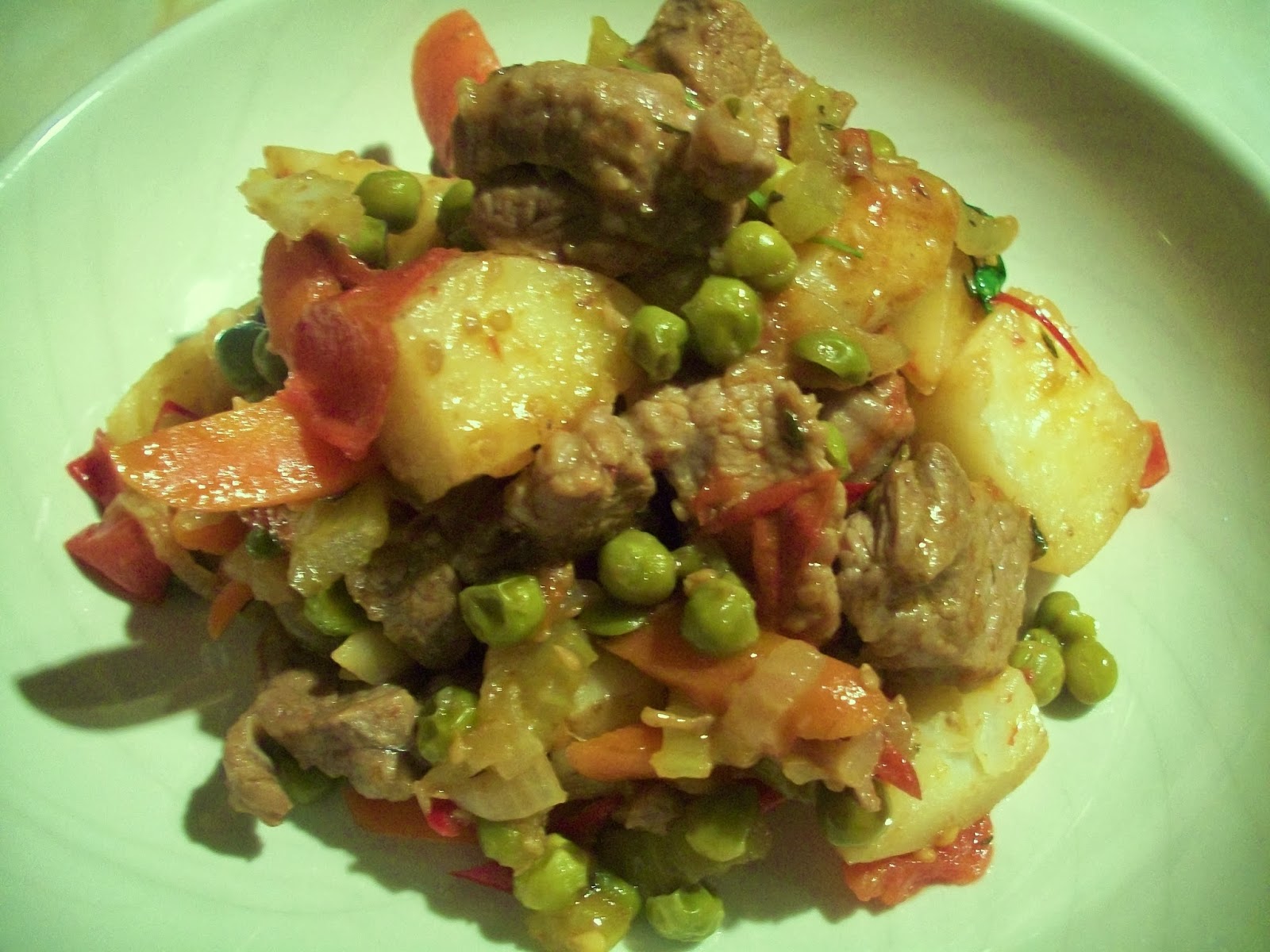
Lamb With Peas


It is very traditional to eat the new season’s lamb with fresh peas at Easter in Italy, and a dish such as this is not uncommon for lunch on Easter Sunday when the whole family will gather together to celebrate one of the most important religious feasts of the Italian year. The secret of this dish is in leaving the lamb to cook over a very low heat, as traditionally it would have been cooked in a pot over the embers of a fire; in this way the lamb and the rest of the ingredients will cook through well, and all the juices will ooze out to create a lovely sauce.

The Recipe

500g boned spring lamb shoulder, cut into large chunks
salt and freshly ground black pepper
extra virgin olive oil
1 onion, roughly sliced
1 carrot, diced
1 celery stalk, diced
2 garlic cloves, sliced 
4 anchovy fillets
handful thyme sprigs
1 red chilli, sliced
175ml white wine
15ml white wine vinegar
125g fresh or frozen peas
200g potatoes, cut into quarters
100g cherry tomatoes, halved
Season the lamb chunks with salt and freshly ground black pepper and set aside.
 
Heat the olive oil in a large lidded pan and fry the onions, carrot and celery for 4-5 minutes, or until softened.
 
Add the garlic, anchovies, thyme and chilli, and continue to cook, stirring, until the anchovies have almost dissolved into the oil. Add the lamb chunks and fry for a further 4-5 minutes, or until browned all over.
 
Stir in the wine and continue to cook until the volume of the liquid has reduced by half, then add the vinegar. Reduce the heat to low, cover and simmer gently for 20 minutes.
 
Add the peas, potatoes and tomatoes, cover again and continue to cook for about an hour, until the sauce has reduced by half.
 
Serve hot with plenty of bread to mop up the sauce.

Monday, 13 May 2013

Parmigiana Melanzane


The dish is claimed by both Campania and Sicily. While "alla Parmigiana" usually means "from Parma", the dish is not really a part of the cuisine of Parma. It is a Southern Italian dish.
 
Many variations are found world-wide, most often in countries where large numbers of Italians immigrated. Examples of dishes developed outside of Italy from the early parmigianas include veal (Veal Parmigiana) or chicken breast (Chicken Parmigiana) dipped in a mixture of beaten eggs, breaded, shallow-fried and topped with a marinara sauce  and mozzarella. It is then usually baked until the cheese is bubbly and brown.

 
The Recipe

2 garlic cloves, thinly sliced
2 x 400g tins chopped tomatoes
1 cinnamon stick
olive oil
1 small bunch basil , shredded
3 medium aubergines
2 balls mozzarella , sliced
a handful grated Parmesan
 
Pre-heat the oven to 180 centigrade/ gas mark 4.
 
Heat a glug of olive oil in a pan, add the garlic and gently cook for 2 minutes.
 
Add the tomatoes and cinnamon and simmer for 15 minutes until thickened. Stir in the basil and season.
 
Slice the aubergines widthways about 1/2cm thick rounds. Brush both sides with oil, season and griddle, turning a few times until completely tender.
 
Remove the cinnamon stick and put a few spoonfuls of the sauce in the bottom of an ovenproof dish. Cover with the aubergine and mozzarella then repeat, ending with a thin layer of sauce.
 
Sprinkle with Parmesan and bake for 30-40 minutes until bubbling and golden.